Ceramics, Print Making

Vignette: Elizabeth Stevenson

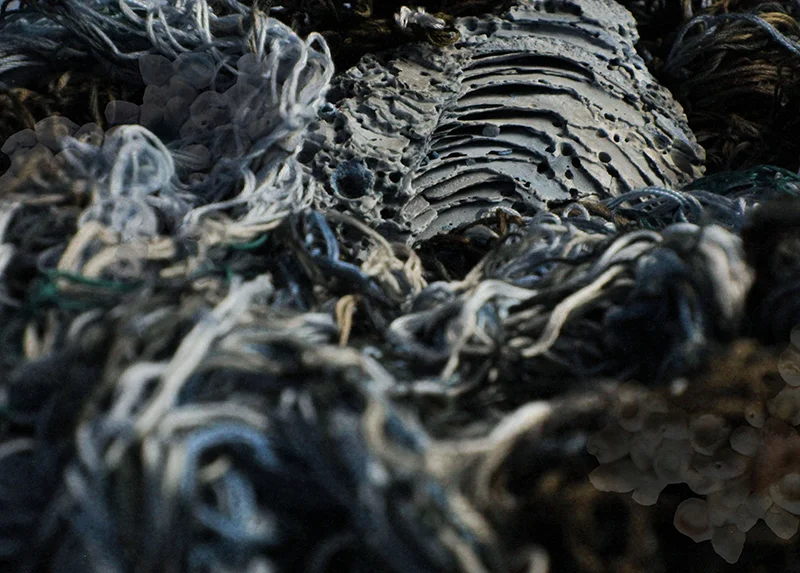
"Untitled #1" by Elizabeth Stevenson, 4.5x4.5x4.5in, fired white clay (2015)

"Untitled #1" by Elizabeth Stevenson, 4.5x4.5x4.5in, fired white clay (2015)

We are officially in the Holocene (“entirely recent”) epoch, which began 11,700 years ago after the last major ice age, but many argue for the current period to be term “Anthropocene”—from anthropo, for “man,” and cene, for “new”—because human-kind has incurred a profound enough impact on the earth to merit the classification. Claims about global warming aside, mass extinctions of plant and animal species, and pollution on a large scale have inarguably changed the planet.
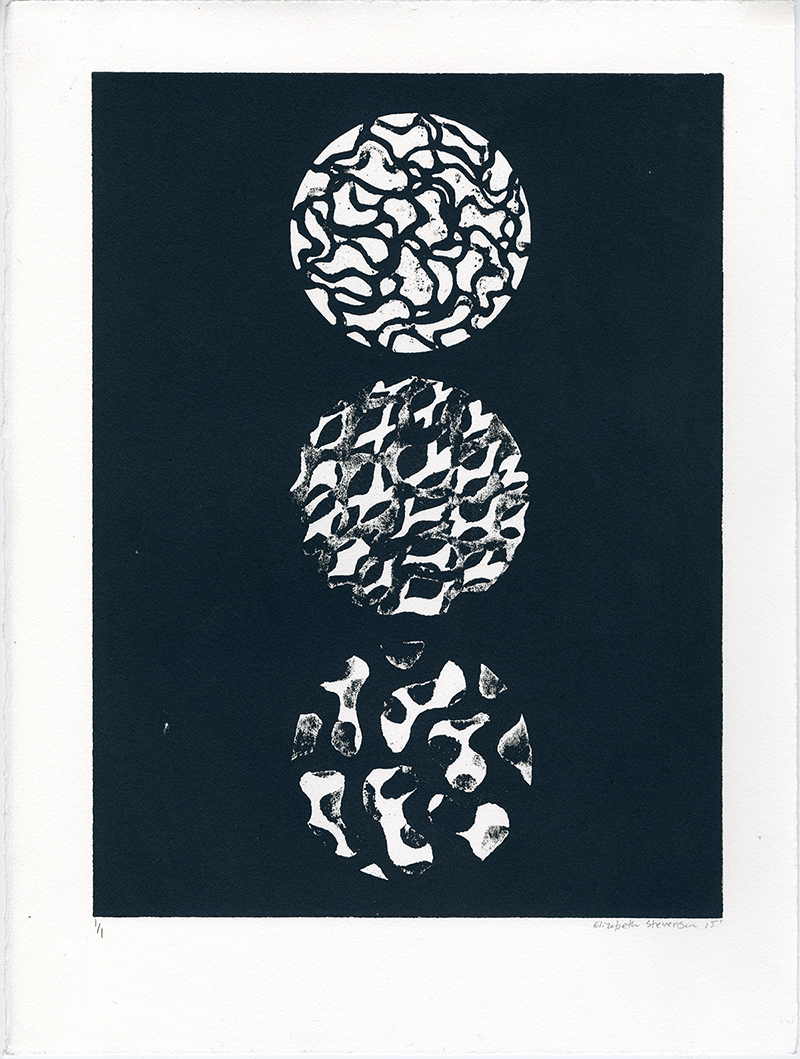
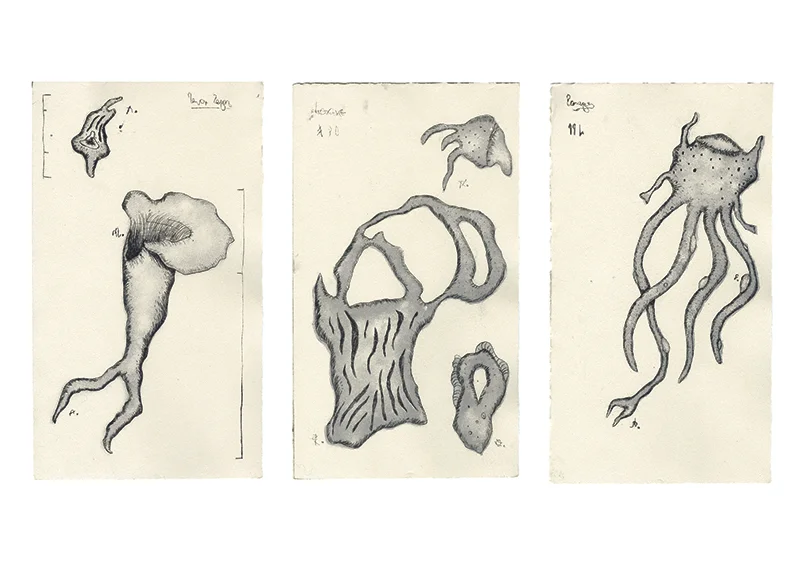
"Untitled #4" by Elizabeth Stevenson, 11x15in, collograph relief print on paper (2015), $150 | BUY NOW

"Untitled #4" by Elizabeth Stevenson, 11x15in, collograph relief print on paper (2015), $150 | BUY NOW

Elizabeth Stevenson is directly inspired by this concept in her work, “… it fueled me to keep creating,” she explains. “Natural patterns are what originally inspired me to create this body of work. The lines I would see in sand when water washed over it or the small orb like forms of pollen particles. After looking to so much of nature for inspiration it made sense to study the science surrounding it. Once I had a better understanding of how nature works and the way in which humans are destroying it I found even more reason to create work motivated by it.”

For Stevenson, the process begins with a study of microscopic images: “Beginning with open organic forms I wished to investigate natural configurations that I saw and abstract them.” In the very beginning, she finds the three-dimensional forms to be soft and fragile, almost vulnerable to the pending manipulation by the artist’s hand. Her carving is primarily deductive, removing mass to create new empty space.

“The forms continued to push me to create and find different processes for making, which led me to develop a more jagged and unraveled representation of the natural world. With these new lines and shapes I began to look to more macroscopic imagery for inspiration. There is a glacial quality in the appearance of the newer pieces, as the lines seem to melt and become undone. Fluid lines drip off into empty space, or are they being contained? All of these forms seemingly contained within a circle, which I can only explain as an attempt to control what I was creating or to control the things that inspire me.”

Age: 21
Hometown: Louisville, Kentucky
Education: BFA candidate, Interdisciplinary Sculpture, Kentucky College of Art + Design at Spalding University, Louisville, Kentucky

"Untitled #3" by Elizabeth Stevenson, 13.5x10.5in, monotype print on paper (2015), $100 | BUY NOW

"Untitled #3" by Elizabeth Stevenson, 13.5x10.5in, monotype print on paper (2015), $100 | BUY NOW

"Untitled #2" by Elizabeth Stevenson, 3.5x3.5x3.5in, fired white clay (2015)

"Untitled #2" by Elizabeth Stevenson, 3.5x3.5x3.5in, fired white clay (2015)

Written by Keith Waits. Entire contents copyright © 2016 Louisville Visual Art. All rights reserved.

Are you interested in being on Artebella? Click here to learn more.

Are you interested in being on Artebella? Click here to learn more.

Mixed Media

Vignette: Steve Heine

“Sweet Camille’s Halo” by Steve Heine, 18x18x2in, laser-cut steel, blue handblown sheet glass, poplar, one of a series of “Cloud Panels” (2015), $2700 | BUY NOW

“Sweet Camille’s Halo” by Steve Heine, 18x18x2in, laser-cut steel, blue handblown sheet glass, poplar, one of a series of “Cloud Panels” (2015), $2700 | BUY NOW

Steve Heine is the owner of Cranium Glass in Louisville, Kentucky, where he is also the chief designer. Although trained as an architect, his work is primarily commissioned art glass for individual and corporate clients.

“Stained glass—composed of glass, paint and metal [lead]—is the prototypical architectural glass form. Currently, I’m working on a fresh approach to architectural glass using these same materials—hand blown sheet glass, paint [stark white metal primer] and metal [laser-cut steel]. My “Cloud Panels” [like stained glass] are designed to be illuminated by the sun. I’m particularly fascinated by the wash of color across steel. I’m working primarily with blue, violet, amber or green hand blown sheet glass for each of my “Cloud Panels”.

“I’m trying to transition to some smaller pieces and gallery sales. However, the high cost of my materials creates a bit of a dilemma for me. So, I’m trying to sell these new "Cloud Panels" by way of a concept drawing and a paper study model [8” x 8”] and images of past, completed pieces. Once a concept is commissioned, I can then make the piece in my studio.”

“Lucent Cloud” (concept drawing on left) by Steve Heine, 18x18x2in, laser-cut steel, blue handblown sheet glass, poplar, one of a series of “Cloud Panels” (2016), $2700 | BUY NOW

“Lucent Cloud” (concept drawing on left) by Steve Heine, 18x18x2in, laser-cut steel, blue handblown sheet glass, poplar, one of a series of “Cloud Panels” (2016), $2700 | BUY NOW

Of course the final glass version is what both artist and viewer are drawn to, yet the minimalist clarity of Heine’s paper models is notable, a clean, simple aesthetic with an appeal all its own. While we envision an artist’s preparation as furiously scribbling on a pad, hands dirty with charcoal or chalk, the architect’s approach is on display here; the merging of the artist’s creativity with the practical functionality of an engineer. 

“Buoyancy” by Steve Heine, paper study model (2016) | Available for Commission

“Buoyancy” by Steve Heine, paper study model (2016) | Available for Commission

During 2016, Heine’s work was accepted in three juried exhibitions: 

•Louisville Visual Art & University of Louisville’s Hite Institute’s Open Studio Weekend Exhibition, juried exhibition, Cressman Center for the Visual Arts, Louisville, KY
• Gathering: Contemporary Glass from the Heartland, juried exhibition “featuring the best of emerging and established glass artists from Indiana, Illinois, Ohio, Michigan, Kentucky and Wisconsin—the heartland of America”, Muncie, IN
• Merit Award in Bluegrass Biennial: A Kentucky Juried Exhibition, Morehead, KY

Heine is now a member of PYRO Gallery in Louisville, and will be featured in the PYRO New Members Show, January 5 through February 11, 2017.

Hometown: Louisville, Kentucky
Age: 55
Education: BA, Architecture, University of Kentucky, 1996; 
Website: http://www.craniumglass.squarespace.com/

“For My Brother, Gary, Who Is Much Older Than Me” by Steve Heine, 7x5(d) in, cast glass [lost-wax process], lathe-turned Kentucky black walnut. The wax positive for the glass was slowly turned by hand on a wood lathe. One of a series of “Wood Lathe …

“For My Brother, Gary, Who Is Much Older Than Me” by Steve Heine, 7x5(d) in, cast glass [lost-wax process], lathe-turned Kentucky black walnut. The wax positive for the glass was slowly turned by hand on a wood lathe. One of a series of “Wood Lathe Vessels”, NFS

A wax model for one of Steve Heine's “Wood Lathe Vessels”

A wax model for one of Steve Heine's “Wood Lathe Vessels”

Are you interested in being on Artebella? Click here to learn more.

Written by Keith Waits. Entire contents copyright © 2016 Louisville Visual Art. All rights reserved.

p.p1 {margin: 0.0px 0.0px 0.0px 0.0px; font: 12.0px 'Helvetica Neue'; -webkit-text-stroke: #000000}
span.s1 {font-kerning: none}
span.s2 {text-decoration: underline ; font-kerning: none; color: #9e4b2f; -webkit-text-stroke: 0px #9e4b2f}For informati…

For information on how you can advertise through Artebella click here.

Digital, Illustration

Vignette: Jessica Booker

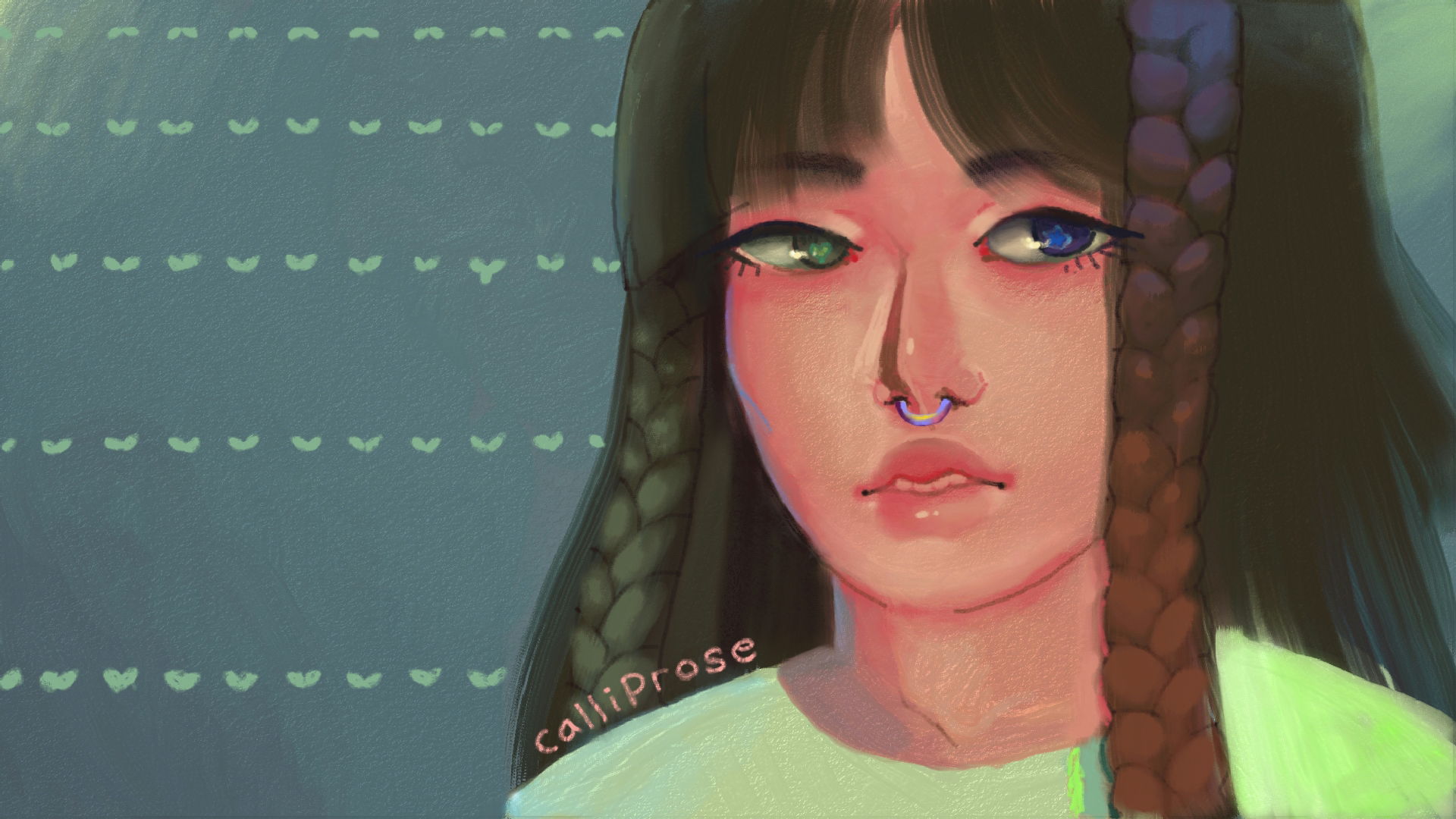
"Braid Boy #3" by Jessica Booker, 1920x1080px, digital illustration (2016)

"Braid Boy #3" by Jessica Booker, 1920x1080px, digital illustration (2016)

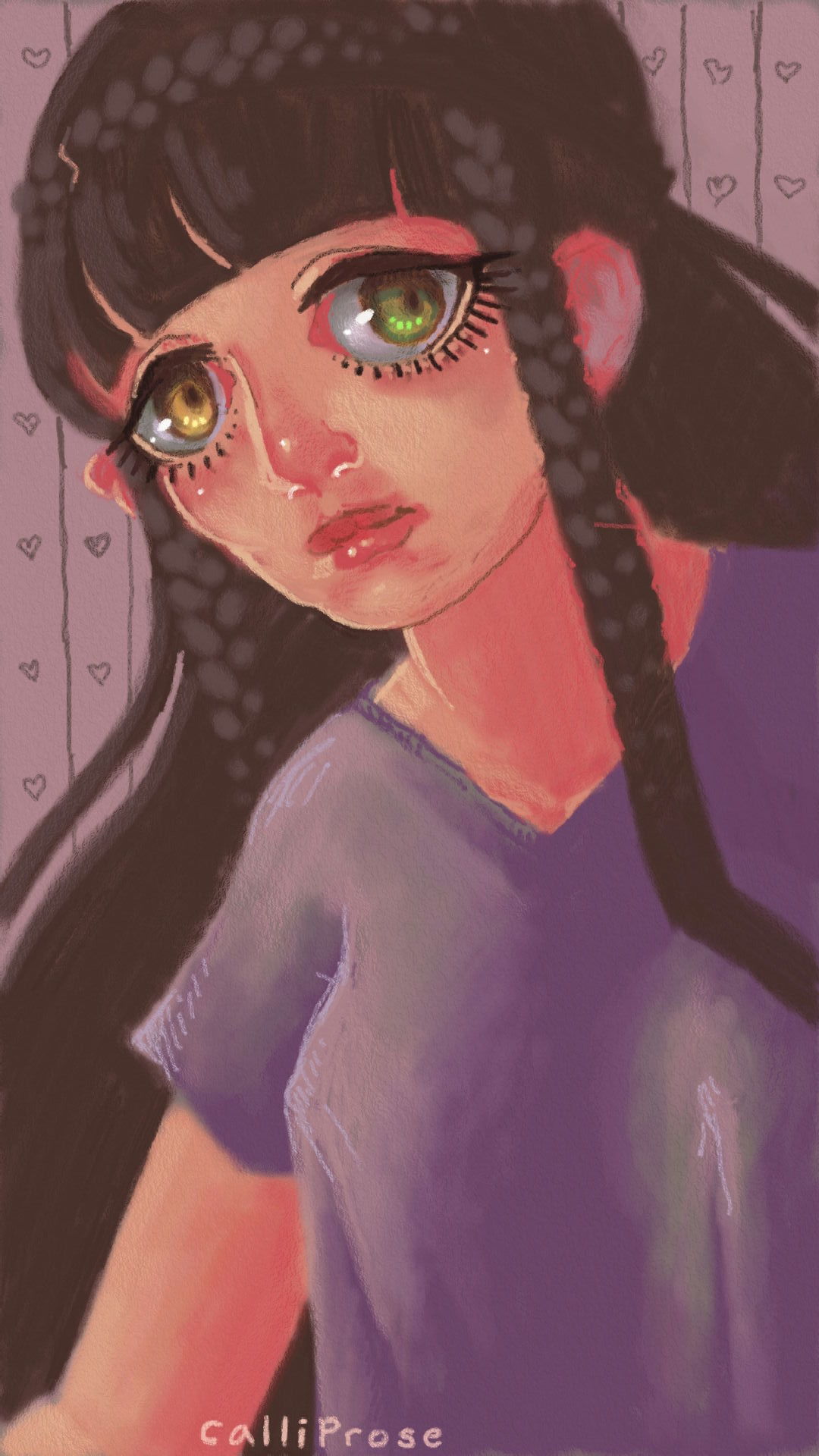
One can see the influence of contemporary illustration and animation in the work of Jessica Booker; that there is a good measure of manga seems obvious, but is there not a also a bit of Margaret Keane, whose “Big Eye” paintings were the source of controversy and an important progenitor of the mass market merchandising of art almost a century ago? 

"Braid Boy #2" by Jessica Booker, 1920x1080px, digital illustration (2016)

"Braid Boy #2" by Jessica Booker, 1920x1080px, digital illustration (2016)

Such a thought is what makes the work of so young an artist interesting. Would Ms. Booker even know Keane, whose court case to claim authorship of her work is now seen as a feminist victory for a female artist so subservient to her husband’s will as to feel it appropriate to bury her creative identity? If time is a river, perhaps artists are unknowingly being caught up in themes and influences like eddies and currents along the way, forever being swept downstream.

"Braid Boy 2.5" by Jessica Booker, 1080x1920px, digital illustration (2016)

"Braid Boy 2.5" by Jessica Booker, 1080x1920px, digital illustration (2016)

Booker works mostly from her imagination, but is inspired by people in her life, a blending of source and sensibility that asks questions about identity in an overly homogenized, culture saturated by digital media. 

She finds the approach somewhat liberating, “…not worrying about getting an exact likeness to someone makes creating more open. They are like idealized caricatures of different persona and personalities I encounter every day. Each face is different in the moment, but similarities start to show and imaginary bonds between these total strangers start to emerge.  

Playing with color, composition, shapes of features - even what they wear, tells what they might be like. Experimenting, for me, is important. Much like actual people, there are similarities and differences. I like to play with the details to make each person unique.”

In high school, Booker received a Scholastic Gold Key Award for Art and Writing. Last year she helped paint a mural on a Spalding University building for SoBro in Louisville.

Age: 21
Hometown: Louisville, Kentucky
Education: BFA candidate, Painting and Drawing, Kentucky College of Art + Design at Spalding University, Louisville, Kentucky

"Braid Boy #1" by Jessica Booker, 1920x1080px, digital illustration (2016)

"Braid Boy #1" by Jessica Booker, 1920x1080px, digital illustration (2016)

"Braid Boy..Wait!" by Jessica Booker, 1080x1920px, digital illustration (2016)

"Braid Boy..Wait!" by Jessica Booker, 1080x1920px, digital illustration (2016)

Written by Keith Waits. Entire contents copyright © 2016 Louisville Visual Art. All rights reserved. 

Are you interested in being on Artebella? Click here to learn more.

Are you interested in being on Artebella? Click here to learn more.

Digital, Illustration

Q&A: Monica Beavers


“Rabbits are a lot smarter and tougher than most people give them credit for.”
– Monica Laake Beavers


"Big, Brown Bunny That Can't (Won't) Hop" by Monica Beavers, 8x10in, mixed media/illustrated book (2016)

"Big, Brown Bunny That Can't (Won't) Hop" by Monica Beavers, 8x10in, mixed media/illustrated book (2016)

Monica Laake Beavers was born and raised in the rolling hills of Northern Kentucky. She has always had a love for art and believes creativity is the spice of life. Monica received her Bachelor of Fine Arts degree, focusing in Graphic Design & Drawing, from Xavier University, and was at one time the Design Coordinator for Louisville Visual Art. She recently finished writing and illustrating her second children's book, "The Big, Brown Bunny Huh?".

When did you first think you would be an artist?

I’m pretty sure I was in kindergarten. The teacher pretty much wasn’t able to take the pencil away from me. I just kept drawing rabbits on everything – my fascination with rabbits started very young.

Who or what inspires you now?

My main inspirations are:

  • Walt Disney: say what you will about him, but I’ve always been a Disney kid from an early age. I respect his creative genius, ambition and persistence he carried throughout his career. He failed so many times early on in his career, but he kept on going. 
  • Movies, specifically Indiana Jones. I want my art to be able to force people to take a breather from the seriousness and monotony of life and just enjoy a moment, even if it’s fleeting. 
  • Saul Bass inspires me artistically. (Bass 1920 – 1996) was an American graphic designer and Academy Award-winning filmmaker, best known for his design of motion-picture title sequences, film posters, and corporate logos). He always focused on the communication of design and art. He was able to take complex opening scenes to films and simplify them to their bare minimum. When creating my books, I’ll try to start with a complex idea and try to simplistically break it down using a rabbit or other animals to typically convey the message in a lighthearted manner.
  • I’m very much fueled by quotes as well, specifically Charles Bukowski and Rudyard Kipling. 
Website_Pages_RGB-01.jpg

Why rabbits? Tell us about the real-life “Bun.”

The bun, the myth, the legend! I’ve loved rabbits as long as I can remember. 

I chose rabbits because of my own pet rabbit, Grumpy, as well as my love for personification. Grumpy has a unique personality and had a very rough upbringing. I wanted to bring this personality to life. Grumpy may appear crotchety and not very trusting of those who first meet him, but he has a heart of gold! 

Grumpy, aka “Bertie McBean” (his stage name for the books), is a French lop by nature and a bunny jam packed with disdain. Hailing from Cleveland, OH, he was saved from a hoarding situation and relocated to Indyclaw Rescue in Indianapolis, IN. One fateful day, he was adopted by a lady (me!) and meandered to Louisville, KY. His knack for traveling and zest for life blew him upstream to Bellevue, KY where he currently resides. He is a free-range rabbit who loves acoustic music (especially Eddie Vedder), the smell of feet, and apples.

You also are heavily into sharks, and there is at least one shark painting on your website. These two animals wouldn’t seem to be a natural match, yet they dominate your unique sensibility. Why is that?

I think from both sides of the spectrum, they are extremely misunderstood animals and ridiculously interesting. Rabbits are a lot smarter and tougher than most people give them credit for. They have a lot of admirable qualities and unique habits (thumping, chinning, binkying, etc.). On the shark end, I’ve always been fascinated knowing they have been in existence practically since the beginning of time and yet have never had to evolve nearly as much as most animals have. Again, they are extremely misunderstood animals but carry a very weighty reputation. 

Additionally, both animals have such unique characteristics they’re a lot of fun to play around with and personify. 

You can draw and paint old school, but why do the two books you have published rely on computer graphics? 

I think this stems from my college Graphic Design professor Jonathan Gibson. He very much emphasized the importance of keeping a human touch when creating a design piece. He stressed the importance of texture and use of mixed media when designing. Too often people rely on a computer to create textures/effects and as a result, a lot of art can begin to look monotonous and generic and lack personality. 

"Big, Brown Bunny That Can't (Won't) Hop" by Monica Beavers, book marks, mixed media/illustrated book (2016)

"Big, Brown Bunny That Can't (Won't) Hop" by Monica Beavers, book marks, mixed media/illustrated book (2016)

My love of art began with drawing and transitioned into graphic design, but I like to use the two interchangeably. When creating my illustrations, I actually start by sketching them all out on a notepad. I then take photographs of textures that have personal meaning to me. For example, I’m a Red’s fan, so a lot of the grass used is from the Red’s stadium. Additionally, the furs used for Grumpy/Bertie McBean are actual photographs of his fur.

Additionally, depending on the project I first start with the idea and what my main message is. From there I select the medium to work in accordance to the theme of the piece. My current style wouldn’t necessarily be used if the message were different. I felt like this style captured the personality of Bertie McBean and what I was trying to convey. 

If you could do anything else but make art, what would it be?

I would be a marine biologist or zoologist, travel the world and study sharks.

What frightens you the most?

I hate caterpillars - really, …I do. In all seriousness though, my biggest fear is losing the ones I love the most and not following my dreams and looking back years from now and asking “what if…?”

What challenges you more than anything?

The question “what if?”

What is your favorite music to listen to when making art?

I typically mix it up between Eddie Vedder/Pearl Jam, Pokey LaFarge, Jim Croce, or the Eagles. 

I usually listen to pretty chill music when making art. I’ve been listening to the Into the Wild soundtrack a lot lately.

Favorite movie? Besides Jaws, that is?

Ha! I think, “I’m going to need a bigger boat” for that question (wokka wokka). Although it is hard to beat, Indiana Jones & the Last Crusade is my favorite. In my eyes, it’s the perfect storyline and end to a trilogy (the fourth movie didn’t happen). It includes a just the right amount of campiness, wit and quirk that separates it from a standard action/adventure movie.

What are you reading right now?

I’m in between three books, “Ham on Rye” by Charles Bukowski, “A Separate Peace” by John Knowles, and David Sedaris’ “Chipmunk Seeks Squirrel.”

What advice would you give a young artist just out of college?

Don’t get frustrated. Each path and experience will lead you where you want to be as long as you don’t lose sight of where you intend to go. After graduating you leave feeling like you’re on top of the world and reality starts to sink in with work, but remember, you chose art for a reason. You always have options and you chose art because you didn’t want a boring life.

If you were given a $100,000 what would do with it?

Start my own company full time and work on branding The Big, Brown Bunny. Start up my own rabbit rescue and probably travel to Egypt, Greece or South Africa- great shark diving area.

What does art mean to you?

Art means happiness. It’s my escape. It allows me to take a break from the real world and just create. It means taking a closer look at things and not accepting things as they are, it means endless possibilities.

If you could meet any celebrity who would it be and what would you ask them?

Walt Disney – What inspired you? What would you hope people remembered you for? What kept you going on the hard days? 

Harrison Ford – I would have to ask about Indiana Jones.

Hometown: Villa Hills, Kentucky
Age: 28
Education: BFA, Xavier University
Website: http://www.bigbrownbun.com

"Big Brown Huh?" by Monica Beavers, 8x10in, mixed media/illustrated book (2015)

"Big Brown Huh?" by Monica Beavers, 8x10in, mixed media/illustrated book (2015)

Bunny+Pages-01_2.jpg

Entire contents copyright © 2016 Louisville Visual Art. All rights reserved.

Are you interested in being on Artebella? Click here to learn more.

Are you interested in being on Artebella? Click here to learn more.

Photography, Fiber, Installation

Vignette: Sarah Kinslow

"Parachute Room" by Sarah Kinslow, 25x14in, still frame of cinemagraph (2016), $100 | BUY NOW

"Parachute Room" by Sarah Kinslow, 25x14in, still frame of cinemagraph (2016), $100 | BUY NOW

Artists change over time. As a student in LVA’s Children’s Fine Art Classes, Sarah Kinslow was adept at highly detailed pen & ink drawings, the highlight of a portfolio that earned her a scholarship. Now in art school, she has shifted into fiber as a medium: “From a young age I was introduced to the art world via textile crafts such as crocheting, knitting, embroidery, cross-stitch, and many other processes. This was part of my everyday life and it impacted the trajectory of my career path early on. Through these processes I have been able to express myself and look to other artists following the same lines.”

Like many artists that work with fiber, Kinslow has an acute awareness of the history and heritage of these techniques as, "woman's work" or as menial household activities that, however important to daily life they might have once been, they were not by any means considered art.

“I want my work with textiles to give the viewer a different perspective, and provide them a place visually or physically to see that these realities are not what we may perceive them to be. They are to question what impact they themselves have on to the pieces, such as my installation work, and what their presence does to the work and their impact on their own reality.” 

Who wouldn’t welcome the opportunity to revisit the tent forts of their childhood? Kinslow’s installations are at once modern and traditional, anachronistic yet cozy. By building space that invites a viewer to sit in quiet contemplation, she explores the layers of meaning in the word “comfort” and reconnects us to the fundamental touchstones of family with a sure sense of place. The larger cultural associations can run even deeper, with the universality of a tented enclosure found in enough history to provide a common thread of understanding.

Hometown: Louisville, Kentucky
Age: 20
Education: Currently a student at the Kentucky College of Art and Design at Spalding University, Louisville, Kentucky for a BFA in Painting/Drawing and Pre-Art Therapy.

"A Place For Contemplation #2" by Sarah Kinslow, 30x20in, digital photo of installation (2016)

"A Place For Contemplation #2" by Sarah Kinslow, 30x20in, digital photo of installation (2016)

"Exploration #4" by Sarah Kinslow, 6x10in, monotype dry point print (2016)

"Exploration #4" by Sarah Kinslow, 6x10in, monotype dry point print (2016)

"Fluidity" by Sarah Kinslow, 20x14in, digital print (2016)

"Fluidity" by Sarah Kinslow, 20x14in, digital print (2016)

Sarah Kinslow (2016)

Sarah Kinslow (2016)

Are you interested in being on Artebella? Click here to learn more.

Written by Keith Waits. Entire contents copyright © 2016 Louisville Visual Art. All rights reserved.

For information on how you can advertise through Artebella click here.

For information on how you can advertise through Artebella click here.