Installation

Feature: Vinhay Keo's Confront at Moremen Moloney Gallery

On March 1, 2018, Louisville Visual Art Honors The Stars Among Us, a luncheon event which will recognize artists and patrons in four categories:

Vinhay Keo - Rising Star Award - In Memory of Bob Thompson
Wilma Bethel - Visual Art Educator Award - In Memory of Anna Huddleston
Porter Watkins - Benefactor of the Year Award - In Memory of Charlotte Price
Elmer Lucille Allen - Legacy Award - In Memory of Julius Friedman

This review, reprinted with permission, discusses Vinhay Keo's fall 2017 solo exhibit in Louisville. 
21764752_352847698504453_5429785149238075142_n.jpg

Confront – Vinhay Keo

Moremen Moloney Gallery
September 15 – October 14, 2017

Review by Keith Waits. Originally published by Arts-Louisville in October 2017.

Entire contents copyright © 2017 Keith Waits. All rights reserved.

Louisville has a thriving visual arts scene, but it lacks a meaningful representation of installation work with the artist’s personal involvement. It happens in other cities, but most exhibition spaces here tend to traffic in fairly traditional presentations. Academic galleries tend to come closest to fulfilling this need, but even they offer such programming intermittently.

Vinhay Keo is only a little more than a year out of the BFA program at Kentucky College of Art + Design at Spalding University (KyCAD), and Moremen Moloney Contemporary Gallery is hosting his first solo exhibition, Confront. The Cambodian-born artist here follows up on his work from the school’s 2016 BFA exhibit, some of which is included here.

Like many artists at this age, Keo is preoccupied with identity. His experience of moving to Bowling Green Kentucky and searching for a place in a smaller American community is realized through a monochromatic aesthetic in which the artist is continually surrounded, nay, overwhelmed by the color white. The Moremen Moloney environs, a renovated home, provide an interesting format by forcing the elements into individual rooms. Keo himself stands in the center of the first room on the left, motionless and silent, naked from the waist up, his lower half wrapped in white fabric and his neck adorned with a stiff white collar from which emerges a long white tie. The tie transitions from broadcloth to a twisted cord that reaches out of the room, across the hall and into the opposite room, where it disappears into an enormous, multi-peaked mound of confetti that is, of course, white.

The hallway displays photographic images printed on aluminum, five of which are specifically created for Confront, and several others that are from his time at KyCAD and the BFA exhibit. In the live installation, Keo’s brown skin is rich and warm in contrast to all of the white. The interior décor is analogous to the austerity of Keo’s imagery, and he has dusted his natural skin tone with white powder on his shoulders.

21752049_1933555133337902_715275688224805592_n-225x300.jpg

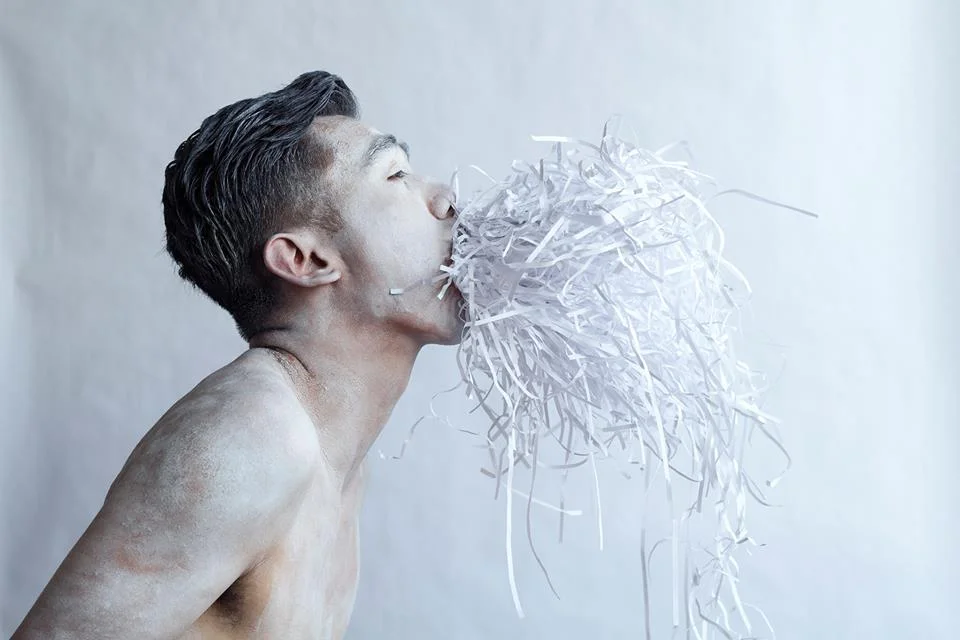
In the photographs, Keo is mostly covered in white make-up, even graying his black hair, or wearing white clothes. His mouth emits viscous white fluid filled with suggestiveness, and in the most striking picture, he appears to vomit a profusion of confetti.

We can draw from all of this that Keo has spent an inordinate amount of time and energy trying to fit into a Caucasian world and that the effort very likely confused the artist’s own sense of himself, his own individual identity. Subsumed by a culture of Bible-belt social mores and backyard barbecues, and with, what we must presume, was a surfeit of similarly brown-skinned neighbors, what degree of denial and willful ignorance must have colored Keo’s own view of himself?

That quality of isolation is pointedly conveyed in this performance installation, set as it is in a high-end exhibition space that draws a well-to-do, predominantly white audience. As Keo stands, stone-faced, the viewers move around him sipping wine and blithely commenting on the artist and his work as if he weren’t within earshot. Is this a replication of Keo’s early life in Bowling Green? The Cambodian boy as the Other? Not fully a citizen and therefore not deserving of full social embrace? If so, Keo has provocatively forced the viewer to be complicit in realizing his statement.

The expression of his thesis is highly intellectual, but the imagery is emotionally charged. And if one stands in the room with Keo, listening to the self-satisfied chatter surrounding him, it is not difficult to empathize with his position. We might expect an artist coming from this experience to put forth a message of protest; to plant his feet and demand recognition for who they are and not who society forces them to be, but Keo codifies his biography into a savvy recognition of his repression.

This reading is reinforced when we consider that Keo is Gay. While it doesn't seem the most important aspect of Keo's projected alienation, at least not in the context of this installation, he references another level of repression in a covert photographic image in which he blocks the view of his genitals with his hands, his entire body, of course, covered in white.

21617607_1933555106671238_2953923890890549455_n-300x225.jpg

Keo has made clear that the overabundance of shredded paper makes reference to the relentless documentation of personal history in the United States. How many bureaucratic forms has Keo filled out in his journey thus far? We are all burdened with such baggage, and it is now a largely digital repository of personal data, but Keo’s paper trail is undoubtedly greater than that of most law-abiding native-born citizens.

As personal as the entire project is, it also strikes a universal chord for all immigrants who come to America as People of Color and/or people for whom English is a second language, and perhaps many others who might not as easily match those descriptions. This positions Confront as one of the more important exhibits of the moment, a commentary that speaks to the chaos in American society, the worth and importance of the immigrant in that chaos, and the very core value of diversity that lies at the heart of the United States of America.

Are you interested in being on Artebella? Click here to learn more.

Painting

Vignette: Kayla Bischoff

"The universal language of humanity spanning across time and geography informs my work." - Kayla Bischoff

"Brouhaha" by Kayla Bischoff, Acrylic on birch panel, 35x54in, 2018, $675

"Brouhaha" by Kayla Bischoff, Acrylic on birch panel, 35x54in, 2018, $675

When Kayla Bischoff cites her influences, Jean Dubuffet seems to be the clearest line: the utter denial of perspective and the embrace of his ‘art brut’ aesthetic, which celebrated the idea of art produced by ‘non-professionals.’ Bischoff certainly is no amateur, but her dense, kinetic compositions are filled with figures and faces rendered in a deliberately unsophisticated style, as if anybody could draw them.

Yet a laymen’s vision of what is accomplished art would arguably still be colored by an ambition to create form and space with detail and depth built from craft. What Bischoff gives us instead are simple images layered one upon another, forcing relationships and building depth through a density of marks that threatens to overwhelm the viewer; except she knows when to pull up. Her world is all surface, but what a busy, busy surface it is.

“The style in which I paint is a balance of abstraction, representation, spontaneous expression, and conscious decisions. The characters are hurriedly drawn in frenzy, and then built upon with several layers of paint to enhance the depth of the surface. I convey my ideas in paintings because the immediacy allows for uninhibited mark making. The tactile nature of the paint feels authentic while connecting me to the earliest form of human visual expression.” 

“As a contemporary artist I actively study and absorb art history. I seek to create a connection between contemporary art and that of past civilizations. I reference ancient artworks, such as figurines and masks from various cultures — Andean, Mesoamerican, Japanese, African, Aboriginal, etc. The universal language of humanity spanning across time and geography informs my work. The use of stylized figures acts as a communicative shorthand of body language and facial `expressions. Through the playfully chaotic layers of figurative abstraction, my work comments on the plight of the individual and humanity as a whole.”

“Gaping mouths, shrugging shoulders, flailing arms, and cackling faces occupy the surface in an overcrowded frenzy. On the surface my paintings are vibrant and playful; however, I invite the viewer to peer closer into the cluttered surface of detailed disorder to discover many of the abstracted figures experience some inner trepidation.”

In 2017, Bischoff had her 2nd solo exhibit, Push/Pull: Paintings by Kayla Bischoff, at Jasper Community Arts: Krempp Gallery, Jasper Arts Center, Jasper IN.

Screen Shot 2017-02-21 at 4.45.04 PM.jpg

Bischoff is having a two-person show with Bob Lockhart at PYRO Gallery in Louisville, February 22 through April 7, 2018. There will be an opening reception Friday, February 23 from 5:00-7:00pm, and a Gallery Talk featuring both artists Sunday, February 25 at 1:00pm.

Hometown: Louisville, Kentucky
Education: BA, (Magna Cum Laude) Studio Art: Painting Emphasis/Minors in Art History & Psychology, Bellarmine University, Louisville, KY, 2014
Website: kaylabischoff.com
Instagram: /knbischoff/
Gallery Representation: Galerie Hertz (Louisville)         

Scroll down for more images

"Egress" by Kayla Bischoff, Acrylic on birch panel, 12 x 12in, 2017, $225 

"Egress" by Kayla Bischoff, Acrylic on birch panel, 12 x 12in, 2017, $225


"Hoopla" by Kayla Bischoff, Acrylic on canvas, 24x30in, 2018, $525

"Hoopla" by Kayla Bischoff, Acrylic on canvas, 24x30in, 2018, $525

"False Faces" by Kayla Bischoff, Acrylic on canvas, 48 x 60in, 2017, $875

"False Faces" by Kayla Bischoff, Acrylic on canvas, 48 x 60in, 2017, $875

"The Blame Game" by Kayla Bischoff, Acrylic on canvas, 36x48in, 2017, $675

"The Blame Game" by Kayla Bischoff, Acrylic on canvas, 36x48in, 2017, $675


Written by Keith Waits. Entire contents copyright © 2017 Louisville Visual Art. All rights reserved.

Are you interested in being on Artebella? Click here to learn more.

Painting

Legacy: Bob Thompson (1937-1966)

“Thompson was in a class nearly by himself in recognition in the world of art. Not until the emergence of Jean-Michel Basquait in the 1980s would another African-American be so embraced.” – from the African American Registry (AAReg).

aaa_thombob_62843_crop.jpg

On March 1, Louisville Visual Art will award Vinhay Keo the 1st Annual Rising Star Award. The award is meant to recognize a young artist who seems poised to have a more widespread impact in the world of visual art. It honors the memory of Louisville-born artist Bob Thompson, and cites his career as an example of exactly what it might mean to be labeled, “rising star.”

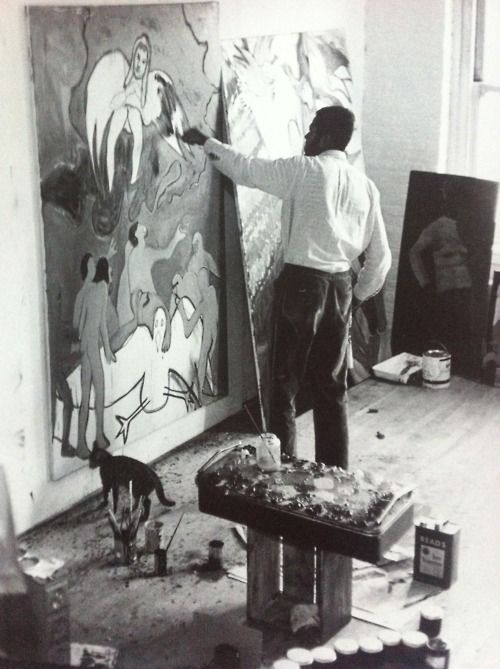
Thompson was born in Louisville but came of age in Boston, where he had been sent to live with relatives after his father was killed in an automobile accident. He entered college as a pre-med student, but increasing depression over the loss of his father left him troubled and unsatisfied. Seeking to alleviate his grief, he returned home to enroll as an art student (with a scholarship) at the University of Louisville in 1956.

According to his entry in Smithsonian American Art Museum, his natural talent and enthusiasm prompted legendary U of L Professor Mary Spencer Nay to encourage him to spend a summer in Provincetown, Massachusetts:

“There were two important art schools in the old fishing village of Provincetown—the Seong Moy Art School and an older, more established institution under the direction of Hans Hofmann, the innovative abstract expressionist painter. One of Hofmann's students at that time was the young artist Jan Müller, who departed from Hofmann's aesthetic principles of nonobjective painting in favor of a figurative style.

Provincetown was an exciting environment for Thompson, and he was especially attracted to Müller's figural paintings and the works of Red Grooms, from Nashville, Tennessee. Grooms was also involved in performances that were later called "Happenings" and represented a new aesthetic concept. Thompson was an active participant in many of Grooms' productions.”

94750ae51fa89401d2f8039b0aa45ed0--craft-studios-studio-spaces.jpg

Conventional wisdom for the Louisville artistic community has often held that you have to go elsewhere to “make it”, but Thompson’s story is more fluid than that canard. Coming home was clearly a crucial step in his life - its how he found his true path, yet it also was, in a very short time, the springboard for him to emerge again into the larger world of American Art.

He married Carol Plenda in 1960, and a Walter Gutman Foundation Grant and a John Hay Whitney Fellowship enabled them to spend the first two and-a-half years of their marriage in Europe. Upon their return, Thompson joined the Martha Jackson Gallery, where all of his exhibits made a sensation, and he sold consistently well: his work was purchased for the permanent collections of prominent museums like the Hirshhorn Museum and Sculpture Garden, Metropolitan Museum of Art, and the National Gallery of Art.

Thompson’s paintings range from a large-scale, gestural abstract to a more figurative expressionism. He drew obvious inspiration from the old masters he had studied firsthand in Europe, forming compositions of biblical narratives and classical mythology rendered with an expressionist’s sense of form and color.

"Stairway to the Stars" by Bob Thompson c.1962, oil and photostat on Masonite, 40x60in, © Estate of Bob Thompson

"Stairway to the Stars" by Bob Thompson c.1962, oil and photostat on Masonite, 40x60in, © Estate of Bob Thompson

As part of the Hite Art Institute’s 75th Anniversary Celebration, the University of Louisville mounted an exhibit in 2012, Seeking Bob Thompson: Dialogue/Object, which was curated by Hite Art Institute Gallery Director John Begley (now retired), and Slade Stumbo, who at the time was finishing his Curatorial MFA at Hite.

Michael Rosenfeld Gallery LLC is the exclusive representative of the estate of Bob Thompson. Since 1996, they have presented four solo exhibitions of the artist’s work, and published catalogues for three of the shows. Most recently, the gallery presented Naked at the Edge: Bob Thompson in 2015.

Permanent Collections: (select) Art Institute of Chicago (Chicago, IL); Brooklyn Museum (Brooklyn, NY); Chrysler Museum of Art (Norfolk, VA); Crystal Bridges Museum of American Art (Bentonville, AR); Detroit Institute of Arts (Detroit, MI); Hirshhorn Museum and Sculpture Garden, Smithsonian Institution (Washington, DC); The Metropolitan Museum of Art (New York, NY); Minneapolis Institute of Art (Minneapolis, MN); Museum of Contemporary Art (Chicago, IL); Museum of Fine Arts (Boston, MA); Museum of Modern Art (New York, NY); Nasher Museum of Art,  Duke University (Durham, NC); National Gallery of Art (Washington, DC); New Orleans Museum of Art (New Orleans, LA); Philadelphia Museum of Art (Philadelphia, PA); Smithsonian American Art Museum (Washington, DC); Solomon R. Guggenheim Museum (New York, NY); Speed Art Museum (Louisville, KY); The Studio Museum in Harlem (New York, NY); Tougaloo Art Collections, Tougaloo College (Tougaloo, MS); Wadsworth Atheneum Museum of Art (Hartford, CT); and Whitney Museum of American Art (New York, NY).

“Le Roi Jones and his Family” (1964) by Bob Thompson, oil on canvas, Hirshhorn Museum and Sculpture Garden, Smithsonian Institution, Washington, DC (© Estate of Bob Thompson; courtesy of Michael Rosenfeld Gallery LLC, New York, NY

“Le Roi Jones and his Family” (1964) by Bob Thompson, oil on canvas, Hirshhorn Museum and Sculpture Garden, Smithsonian Institution, Washington, DC (© Estate of Bob Thompson; courtesy of Michael Rosenfeld Gallery LLC, New York, NY

"Untitled (Michelangelo's Fall of Phaeton)" by Bob Thompson, 1963, gouache on paper (page from art catalogue), 12 1/8x8 3/4in, signed and dated, © Estate of Bob Thompson

"Untitled (Michelangelo's Fall of Phaeton)" by Bob Thompson, 1963, gouache on paper (page from art catalogue), 12 1/8x8 3/4in, signed and dated, © Estate of Bob Thompson

"The Judgement" by Bob Thompson, 1963. Oil on canvas, 60x84in. Brooklyn Museum, A. Augustus Healy Fund, 81.214. © Estate of Bob Thompson (Photo: Brooklyn Museum, 81.214_SL1.jpg)

"The Judgement" by Bob Thompson, 1963. Oil on canvas, 60x84in. Brooklyn Museum, A. Augustus Healy Fund, 81.214. © Estate of Bob Thompson (Photo: Brooklyn Museum, 81.214_SL1.jpg)


Written by Keith Waits.
In addition to his work at the LVA, Keith is also the Managing Editor of a website, www.Arts-Louisville.com, which covers local visual arts, theatre, and music in Louisville.

Are you interested in being on Artebella? Click here to learn more.

Photography

Vignette: Ku Hone

“An air of alienation, desolation, despair, aloneness is often pungent in my photos.” – Ku Hone

"City under Abstraction" by Ku Hone, Photograph, 11x14in, 2016 $200

"City under Abstraction" by Ku Hone, Photograph, 11x14in, 2016 $200

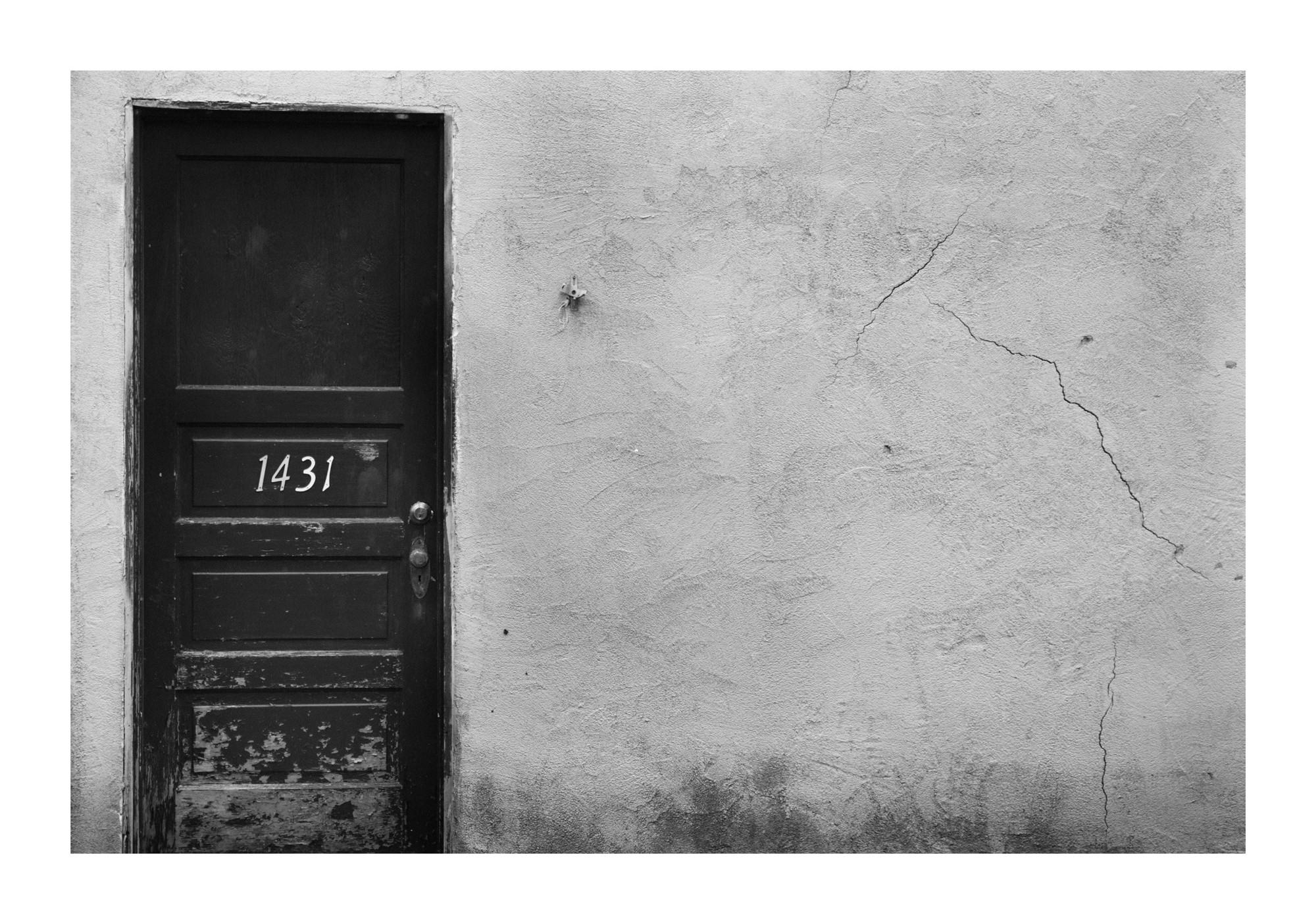
Ku Hone is a photographer whose images encapsulate a fluid sense of place. His images seem to be taken at a very specific location, yet do not necessarily hold the information to identify exactly where we are. They are at once one, specific place and many other places. “Brooding Alley” includes what we assume is a street number, a salient detail by which to gain one’s bearings, but “Lines of Decay” and “Forms in White” speak on mostly abstract terms, the former image evidently modern architecture but the latter proves more elusive, much harder to pin down place or time except as an instance in the mind of the photographer.

Born in South Korea in 1974, Hone has been living in Louisville since 2010. His interest in photography started in early teenage years, but, while holding multiple academic degrees, he has received no formal training in art or photography.

"Lines in Decay" by Ku Hone, Photograph, 16x20in, 2017 $200

"Lines in Decay" by Ku Hone, Photograph, 16x20in, 2017 $200

“My work attempts to gain new perspectives on the ordinary. I believe that only in a state of confusion can one’s mind spring out towards a new direction. Objects, patterns and such are no longer amusing once one makes the association between the subject and a preconceived idea of the subject already in one’s mind. I often strive to de-construct space in order to gain new (and often confusing) views of ordinary objects. The ultimate goal of such attempts is to kindle the viewers’ imagination and help them appreciate the beauty of the mundane.

“I also thrive in empty space or void. I believe negative space is not simply used to counter-balance positive space but to facilitate a new creative space where the viewer is able to project oneself into the scene. In that sense, it is an invitation to explore and to contemplate. For this reason, simple and minimalistic compositions of lines, curves, geometrical shapes, symmetrical and asymmetrical patterns and textures are abundant in my work. I believe that our innate perception of beauty in nature and objects is based on recognition of basic forms and shapes found within them. And this is how arrangements of simple (and seemingly meaningless) forms can give rise to beauty, meaning, and ultimately, emotions.”

“My work harnesses the absurdity of life. It is what alienates oneself from the world and the life itself. However, one must live on in the face of absurdity, forever searching for the elusive Emperor’s clothes. I believe streets of urban life reflect this struggle. Abandoned objects and disintegrating walls clash with and clutter our life. Exotic and vivid colors clash with one another, juxtaposed with neutral tones. The old clashes with the new. I believe my job is to find beauty and balance in such scenes in an attempt to find hope in the absurdity.“

"Fantasia Nebbiosa" by Ku Hone, Photograph, 16x20in, 2017 $200

"Fantasia Nebbiosa" by Ku Hone, Photograph, 16x20in, 2017 $200

Hone is participating in Abstract in Kentucky, a Juried Exhibition running through February 24, 2018 at Kaviar Forge and Gallery in Louisville. He will also be a part of the Mellwood Art Center Spring Art Fair, February 24 & 25, and, later in 2018, the Open to Interpretation exhibit at the Community Arts Center in Danville, KY.

Hometown: Seoul, Korea
Education: BS, Environmental Toxicology, University of California, Davis, Davis, CA; MS & PhD, Toxicology, University of Rochester, New York
Website: https://500px.com/kuhone
Instagram: /ku_hone/


Scroll down for more images

"Brooding Alley" by Ku Hone, Photograph, 11x14in, 2017 $200

"Brooding Alley" by Ku Hone, Photograph, 11x14in, 2017 $200

"Forms of White (in Dark)" by Ku Hone, Photograph, 11x14in, 2016 $200

"Forms of White (in Dark)" by Ku Hone, Photograph, 11x14in, 2016 $200

"Mama I Feel The Void" by Ku Hone, Photograph, 11x14in, 2017 $200

"Mama I Feel The Void" by Ku Hone, Photograph, 11x14in, 2017 $200


Written by Keith Waits. Entire contents copyright © 2017 Louisville Visual Art. All rights reserved.

Are you interested in being on Artebella? Click here to learn more.

Print Making

Student Showcase: Kathryn Combs

"Pope Lick Monster" by Kathryn Combs, Lithograph with screen print, 18x25in, 2017, $425

"Pope Lick Monster" by Kathryn Combs, Lithograph with screen print, 18x25in, 2017, $425

Although Kathryn Combs’ image is a simple, albeit dynamic, point-of-view of a train trestle, the incomplete fields of text that fill in the open areas of sky hint at something else; an urban folk legend placed in southeastern Jefferson County that positions the highly-placed train crossing as the home of a hybrid creature known as “The Pope Lick Monster.” The legend includes that the “sheepman” lured young people out onto the trestle, and the facts are that more than one tragic death is tied to the location, which the artist follows through on with grisly, yet enigmatic, suggestion.

"A Story About 1960" by Kathryn Combs, Lithograph, 18x10in, 2017, $200

"A Story About 1960" by Kathryn Combs, Lithograph, 18x10in, 2017, $200

“My work explores the relationship of individual history and common experience. In my art, I combine technology with traditional print media in the form of digitally rendered images put to a plate with any combination of lithography, screen printing, etching, drawing, collage and hand coloring. For each print I conduct intensive research, tapping into public records such as geographical maps, photo archives, and biographical databases. I am also inspired by firsthand accounts, local legends, and oral history. Using these resources, I compose images that contrast familiar scenes with unusual and uncanny features. I like using elements within my prints that play on the viewer’s visual literacy. Glassware and keys become shorthand for domestic life, historical photos of small towns are synonymous with Americana, and famous artworks are tantamount to our entire experience as viewers of art. I interrupt this visual code with color, drawing, and layering of visually represented data (e.g. maps or charts). These interruptions tip off the viewer that there may be more to the image than expected, and convinces them to take a second look.”

Combs uses archival photography to connote specific places and/or times from the past, attempting to connect history to present experience in a combination of collective memory and contemporary printmaking technique.

studio.jpg

Combs’ work will be included in the Senior Thesis Exhibition scheduled to open March 1st at the IU Southeast Barr Gallery in New Albany, Indiana, as well as the Annual Juried Student Art Exhibition, Juried Exhibition, Indiana University Southeast, which runs through February 18, 2018, and was curated by Amethyst Beaver (21c). 

Hometown: Crothersville, Indiana
Education: BFA candidate in Printmaking at Indiana University Southeast - Graduating in May
Website: www.kathryn-combs.com
Instagram:@kathryn.combs.art


Scroll down for more images

"Aaron" by Kathryn Combs, From "Looking Longer" series, Screen print, 15x20in 2017

"Aaron" by Kathryn Combs, From "Looking Longer" series, Screen print, 15x20in 2017

"Christi" by Kathryn Combs, From "Looking Longer" series, Screen print, 15x20in 2017

"Christi" by Kathryn Combs, From "Looking Longer" series, Screen print, 15x20in 2017

"Michelle" by Kathryn Combs, From "Looking Longer" series, Screen print, 15x20in 2017

"Michelle" by Kathryn Combs, From "Looking Longer" series, Screen print, 15x20in 2017


Written by Keith Waits. Entire contents copyright © 2017 Louisville Visual Art. All rights reserved.

Are you interested in being on Artebella? Click here to learn more.